
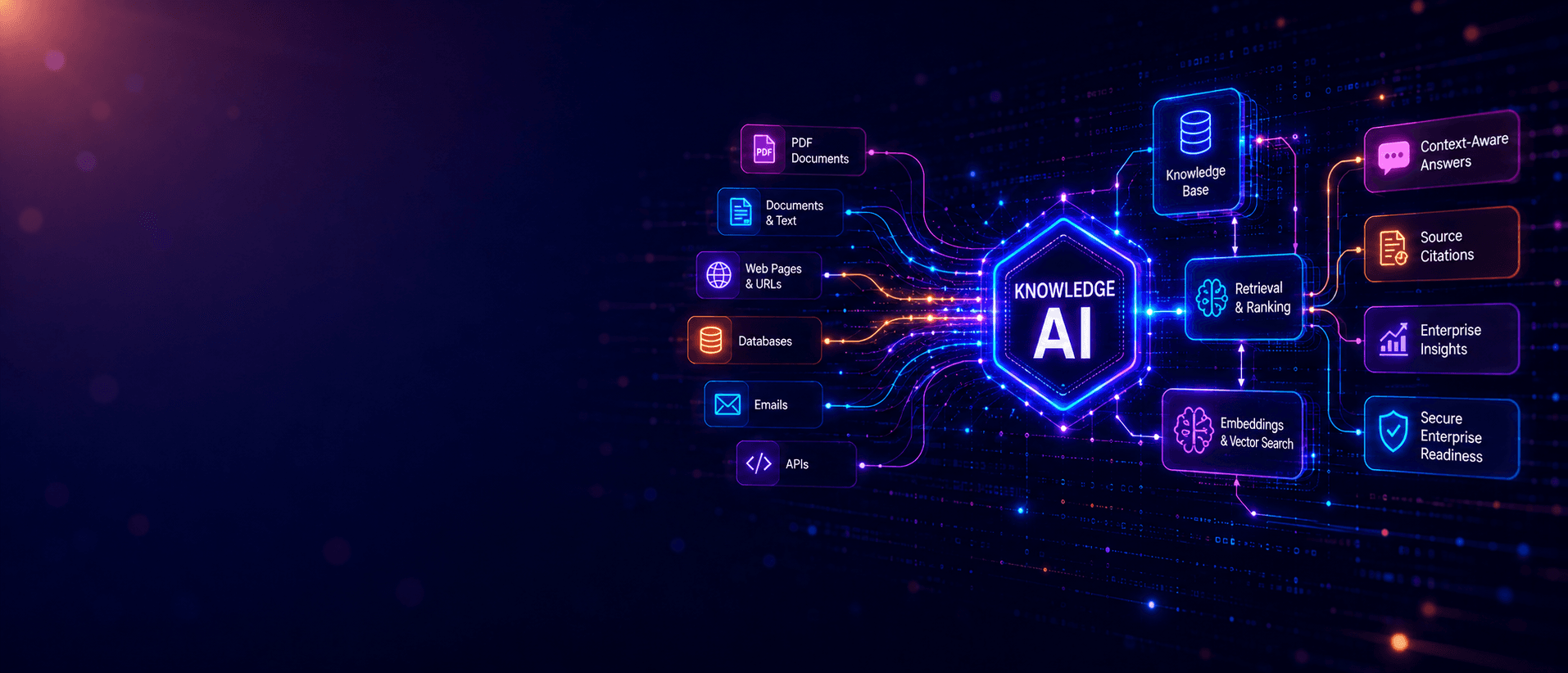
Your AI Answers From
Your Knowledge.
Production RAG systems that connect LLMs to your documents, databases, and internal knowledge, with verified citations, role-based access control, and zero hallucinations.
The Numbers Behind RAG & Knowledge AI
RAG, AI That Knows What You Know
Retrieval-Augmented Generation connects a large language model to your actual organizational knowledge, documents, databases, wikis, emails, so it answers from your data, not its training data.
We build custom RAG pipelines with fine-tuned retrieval, chunk-level access control, and source attribution on every answer, not off-the-shelf wrappers that break in production.
“A hallucinating AI isn't just wrong, it's a liability. RAG with proper grounding is what makes AI safe to deploy on your most sensitive knowledge.”
From Documents → Search → Retrieval → Grounded Answers
Six RAG Capabilities.
One Production System.
Every pipeline we build is tested for retrieval precision, grounded against hallucination, and monitored for knowledge freshness in production.
Where RAG Moves the Needle Most
We've deployed RAG systems across financial services, healthcare, legal, logistics, and enterprise operations. ROI is typically visible within 60 days.
Discuss Your Use CaseRAG That Survives Production
Most RAG demos work on clean PDFs. Real production systems face messy data, access control, stale content, and thousands of concurrent queries. We build for that reality.
From Raw Documents to
Production RAG in 8–12 Weeks
A milestone-driven process with a working retrieval baseline by week 3, not a system you see for the first time at go-live.
Inventory all knowledge sources; documents, wikis, databases, APIs. Assess format diversity, access permissions, and update frequency. Define the query types the system must handle.
Build document parsers for each content type. Tune chunking strategy and embedding model. Populate vector database with metadata-tagged chunks. Deliver retrieval baseline you can test.
Evaluate recall@K against real queries. Layer hybrid BM25 + vector search and cross-encoder re-ranking. Integrate LLM with grounding prompts and citation extraction. Implement RBAC at retrieval layer.
Deploy chat UI or REST API. Connect to your existing tools; Slack, Teams, CRM, helpdesk. Build admin panel for knowledge source management and query analytics.
Go live with full observability; retrieval quality metrics, query latency, citation accuracy. Automated sync pipeline keeps the index fresh as documents change.
Best-in-class tools for your RAG pipeline
Scope-Based Pricing
No retainers. No hidden fees. You own everything we build.
Knowledge discovery, ingestion, clean chunking, vector indexing, secure RAG pipeline, and internal chat UI with source-linked answers.
Multi-source ingestion, advanced chunking, role-based access control, monitoring, and API + UI integration.
Large-scale ingestion, strict governance, private LLM grounding, multi-role access control, and high availability with full audit logging.
All pricing is project-based. You own the IP, source code, and all systems we build. Contact us for a scoped estimate.
RAG & Knowledge AI in the Real World
 Fintech
How Agix engineered an end-to-end AI document processing system that achieves 99.5% extraction accuracy across 5.7M+ financial documents…
The Challenge
Processing financial documents manually, income verification, deposit verification, tax return analysis, is slow,…
The Outcome
Measured 90 days post-deployment against pre-deployment baselines.
Extraction Accuracy
Avg Processing Time
 SaaS Customer Support
Agix partnered with Brainfish to build a RAG-powered support resolution engine that handles 28,000+ monthly conversations, classifying…
The Challenge
In B2B SaaS, 70%+ of all support volume is repetitive, questions with known answers that live somewhere in…
The Outcome
Measured across Brainfish's SaaS customer deployments, spanning 500+ companies and 2M+ monthly interactions, in the 12…
First-Contact Resolution
Escalation to Human
 Financial Intelligence
Agix built the NLP and semantic search layer that powers AlphaSense, replacing weeks of analyst research with minutes by processing…
The Challenge
Financial analysts at major investment firms spend 40–60% of their time reading, summarizing, and cross-referencing…
The Outcome
Measured across AlphaSense enterprise deployments serving investment and strategy teams.
Signal Accuracy
Research Time
Deep Dives on
RAG & Knowledge AI
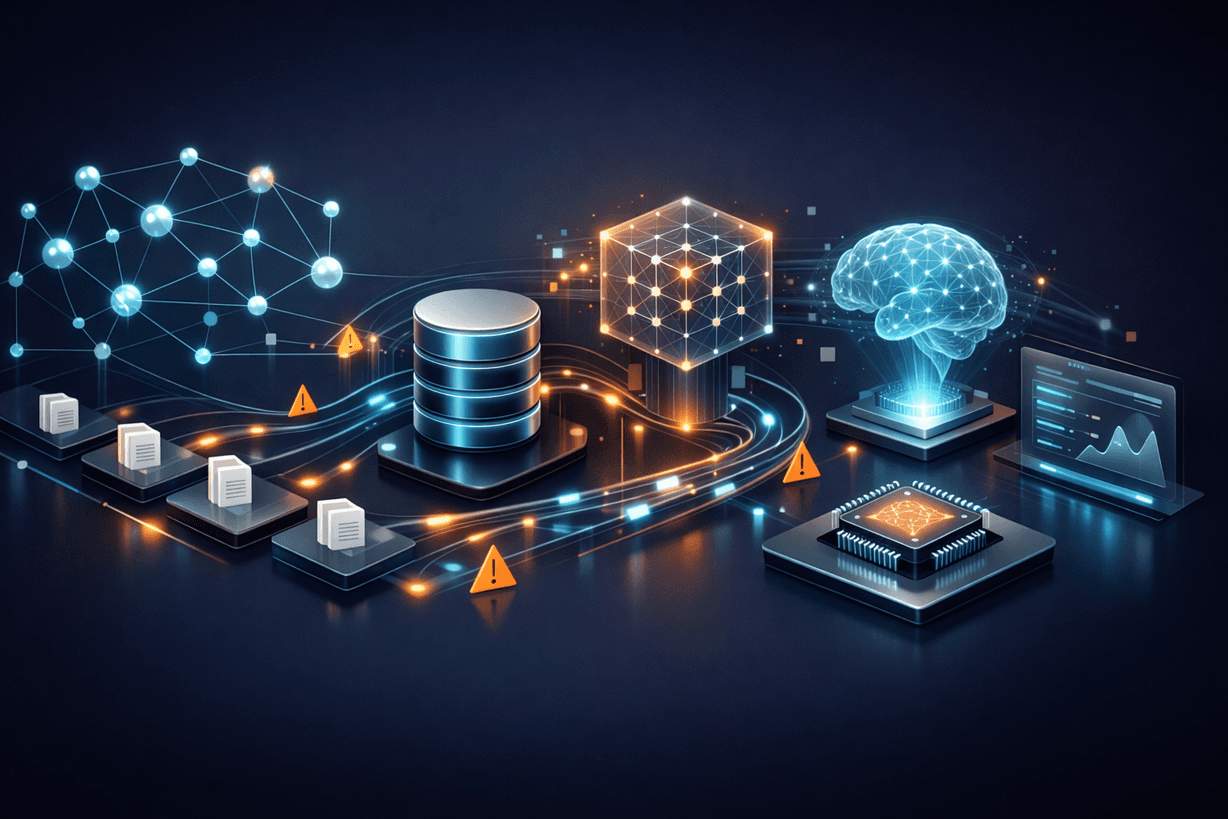
Why RAG Systems Fail: Chunking, Retrieval 5 Architecture Mistakes
Discover Why RAG Systems Fail due to poor chunking, weak retrieval strategies, and critical architecture mistakes. Learn how to improve accuracy and performance.
Read article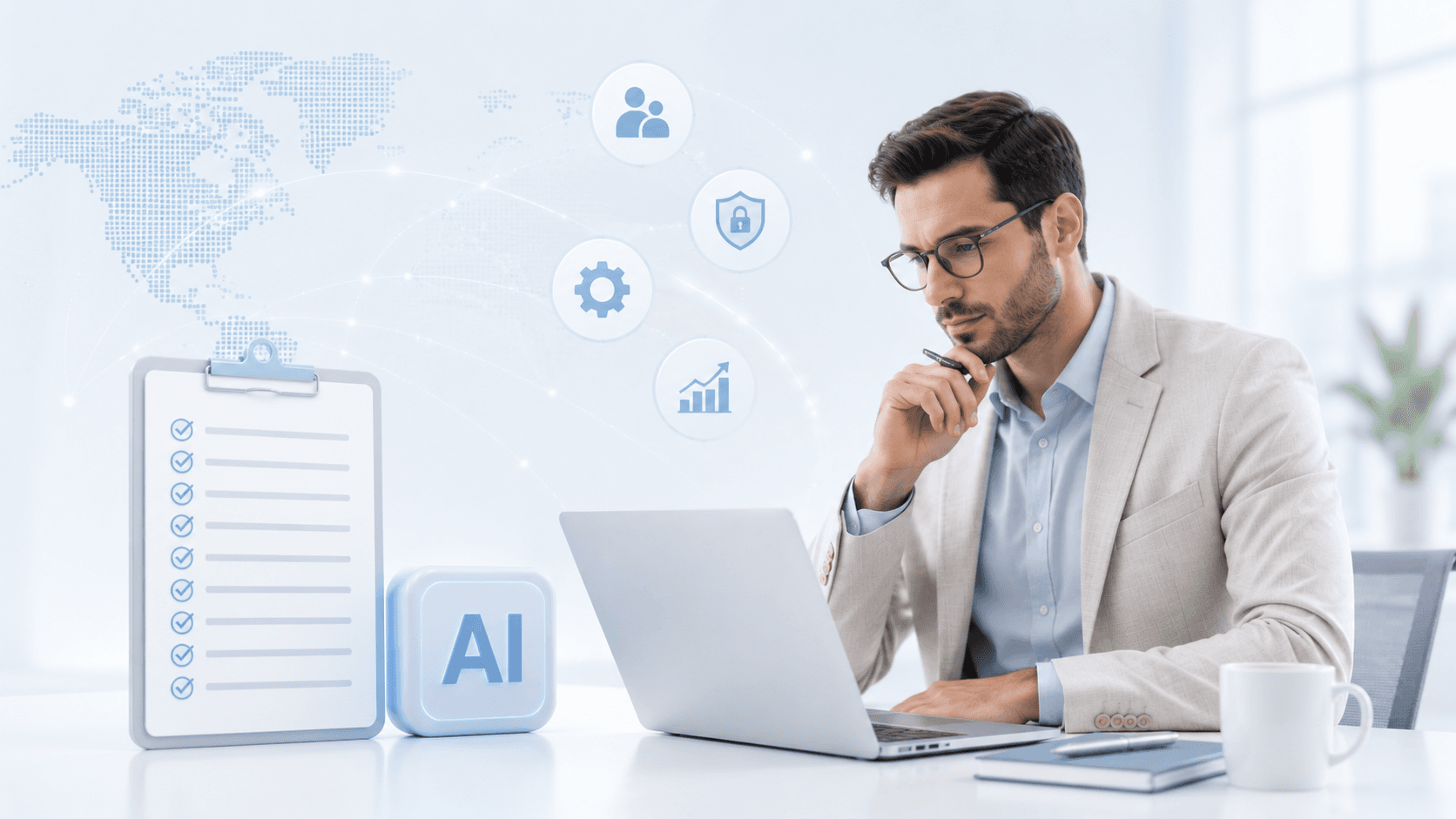
How to Choose an AI Development Company: The 15-Point Vendor Evaluation Checklist for US Enterprises
Choosing the right AI development company in 2026 requires more than a demo. Use this 15-point vendor evaluation checklist built for US enterprise procurement teams.
Read article
AI in Healthcare: Use Cases, Benefits HIPAA-Compliant Implementation Roadmap
Explore AI in healthcare, including top use cases, benefits, HIPAA compliance, implementation roadmap, EHR integration, challenges, and best practices.
Read articleFAQ
We support PDFs, Word documents, PowerPoints, Excel files, HTML pages, plain text, databases (SQL and NoSQL), APIs, SharePoint, Confluence, Notion, Google Drive, email archives, Slack, and custom enterprise systems. If your data exists somewhere, we can typically ingest it.
Through strict grounding prompts that instruct the LLM to only answer from retrieved context. If the answer isn't in the retrieved documents, the system says so rather than fabricating. We also run faithfulness checks that compare the generated answer against the source passages and flag any unsupported claims. This is the service layer behind Enterprise Knowledge Intelligence.
Yes. We implement role-based access control at the retrieval layer, not just at the UI. Before any document chunk is returned to the LLM, we verify the requesting user has permission to view that document. This means users can never receive answers grounded in content they're not authorized to see, even indirectly.
Generic tools use one-size-fits-all chunking and retrieval strategies that work acceptably across many domains but optimally for none. We tune every component, chunking strategy, embedding model, retrieval algorithm, re-ranking layer, specifically for your content types, query patterns, and accuracy requirements. We also build around your exact access control model, data residency requirements, and compliance constraints.
We build automated ingestion pipelines that monitor source systems for changes and re-index affected documents in real time. When a document is updated, outdated chunks are retired and replaced. You can also set staleness thresholds, if a document hasn't been reviewed in N months, it gets flagged rather than silently answered from.
100%. The vector index, ingestion pipeline, retrieval API, and all application code are yours. We deploy to your cloud account (AWS, Azure, GCP, or on-premise) and hand off full documentation. There is no ongoing vendor lock-in; you can maintain, extend, or migrate the system independently after handoff.
Your Knowledge. Your AI. Zero Hallucinations.
Book a free knowledge audit and we'll tell you exactly what retrieval accuracy is possible with your current documents, before you commit.