

Intelligent Document Automation
at Scale for Ocrolus
How Agix engineered an end-to-end AI document processing system that achieves 99.5% extraction accuracy across 5.7M+ financial documents annually.
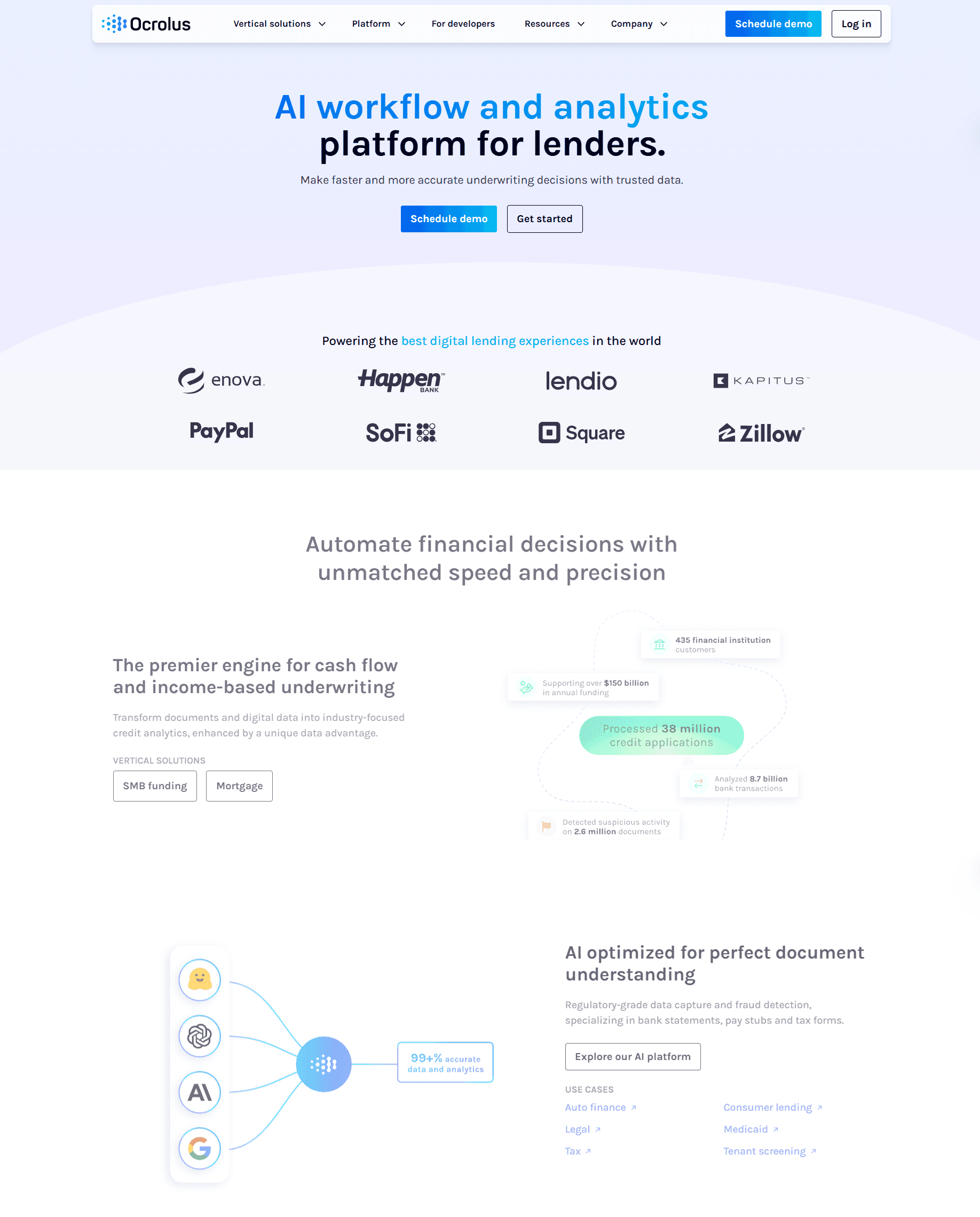
The premier engine for cash flow and income-based underwriting.
Ocrolus is a document intelligence platform built specifically for financial services, mortgage lenders, fintech companies, banks, and loan servicers who need to extract and validate data from financial documents at high volume and accuracy. Their platform processes the documents that drive lending decisions: bank statements, pay stubs, tax returns, and business financial statements.
“How does Ocrolus achieve 99.2% accuracy in financial document processing?”
Ocrolus combines OCR with a financial document-specific ML layer that understands the structure of bank statements, pay stubs, and tax returns at the semantic level, not just the pixel level. Trained on millions of financial documents across thousands of format variants, cross-reference validation checks every extraction against known financial logic rules. Human review is triggered only when confidence falls below threshold.
Manual document review is the bottleneck in loan origination.
Processing financial documents manually, income verification, deposit verification, tax return analysis, is slow, expensive, and error-prone. As loan volumes scaled, document processing became the bottleneck limiting origination throughput.
Financial-document-specific AI with cross-reference fraud detection.
Agix built a document intelligence pipeline trained exclusively on financial documents, with a semantic understanding layer and a fraud detection layer that identifies document tampering and inconsistencies.
Multi-Format Document Classification
Automatically identifies document type, bank statement, pay stub, W-2, 1099, 1040, business P&L, and routes to the appropriate extraction model trained for that document class.
Financial Data Extraction Engine
Extracts structured financial data from any format variant: income, deposits, recurring expenses, account balances, employment info, and tax figures, with field-level confidence scores for every value.
Cross-Reference Validation
Validates extracted data against 140+ lending-specific logic rules: total deposits vs individual deposit sum, stated income vs deposit patterns, tax return figures vs W-2 figures. Catches extraction errors and data inconsistencies.
Fraud Detection Layer
Detects document tampering through multiple signals: digital manipulation artifacts, metadata inconsistencies, rounding patterns, and deposit amounts inconsistent with stated employment. High-risk scores trigger investigation, not auto-rejection.
Human-in-the-Loop Queue
Documents and fields below confidence thresholds are routed to a human review queue with pre-extracted data and confidence reasons. 85% of documents are fully automated, humans only handle genuine edge cases.
Structured Output via API
Delivers all extracted financial data as structured JSON via API, standardized regardless of input format. Pre-built integrations for Encompass, Calyx Point, Byte, and major LOS platforms. Custom integrations available for proprietary systems.
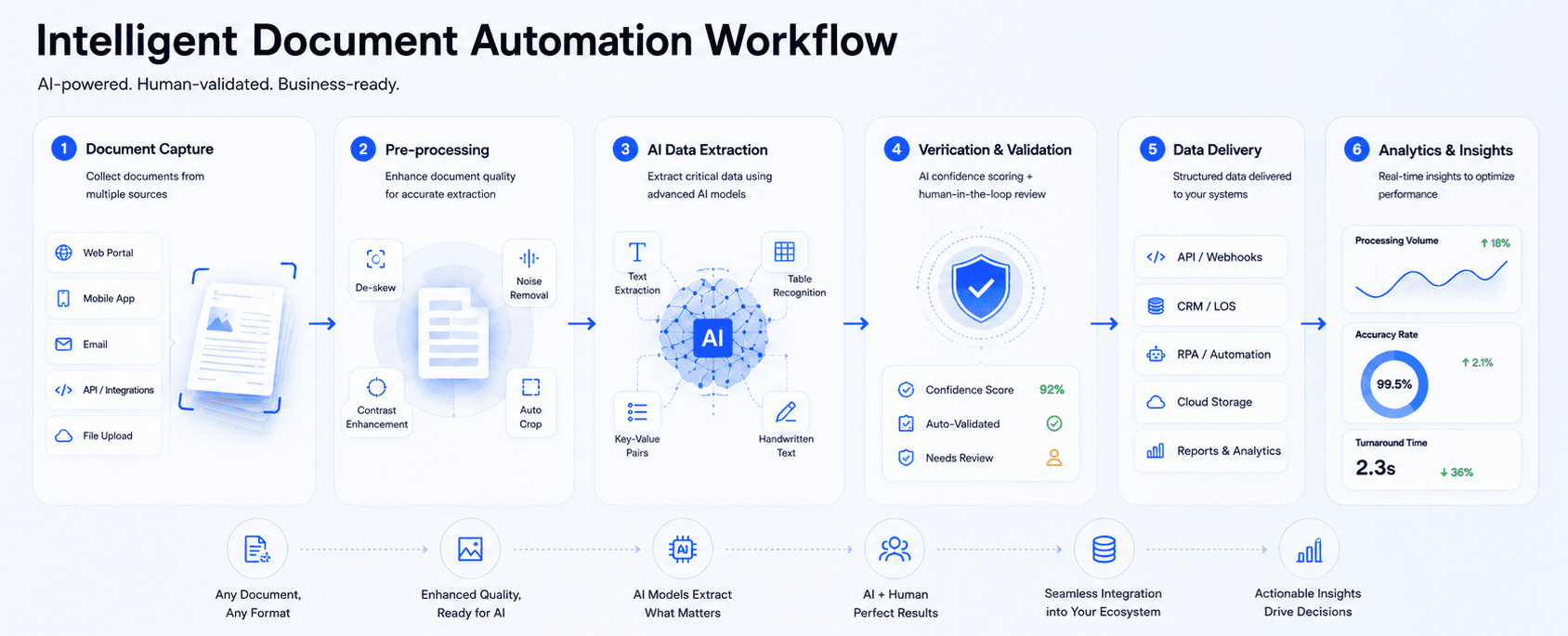
Intelligent document automation, from upload to structured underwriting data.
Classification, extraction, cross-reference validation, fraud scoring, and human review, a single pipeline that turns any financial document into decision-ready data.
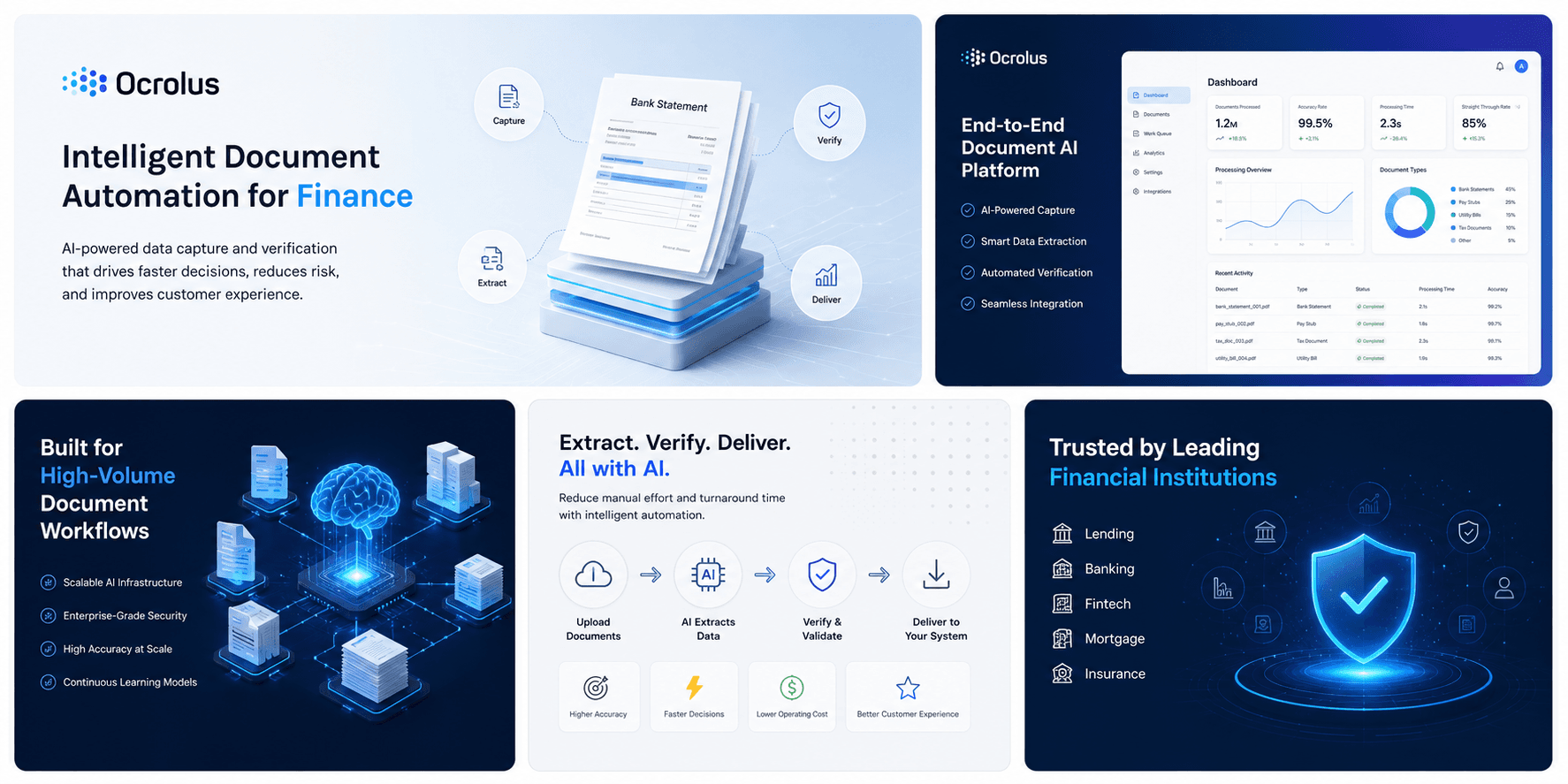
Purpose-built for financial document intelligence.
The Agix-built system handles every document type Ocrolus encounters, across income verification, fraud detection, cash flow analysis, and underwriting intelligence, through a single unified API surface.
Numbers that moved the business.
Measured 90 days post-deployment against pre-deployment baselines.
Ocrolus processes documents I would have sworn couldn't be automated, faxed bank statements from 1997, handwritten deposit records, business statements with custom formats. The accuracy is better than our manual processors, and it flags fraud our team would have missed.
Human-in-the-loop, not human-as-bottleneck.
Training exclusively on financial documents, millions of bank statements, pay stubs, and tax forms in thousands of format variants, produced extraction accuracy that generic OCR tools can't match. Understanding that "Regular Earnings," "Gross Wages," and "Salary" are the same concept regardless of payroll provider was the key capability gap that generic OCR couldn't bridge.
The same cross-reference validation that catches OCR extraction errors also catches document manipulation fraud, making the system dual-purpose without additional complexity. Routing low-confidence documents to human review rather than forcing all output through automated extraction maintained overall accuracy above the threshold customers needed to rely on the output.
Domain-specific training data
Models trained exclusively on financial documents understand lending-specific layouts and terminology.
Semantic field mapping
Understands financial concepts across payroll providers, not just character matching.
Dual-purpose validation
Cross-reference logic catches both extraction errors and fraud, no additional complexity.
Speed as market access
4.7 minutes vs 3–5 days enables conditional loan offers in hours, not weeks, a competitive advantage.
What this system doesn't do well.
Every AI system has constraints. Here's what to know before building something similar.
Physical Document Degradation
Heavily degraded documents, old faxes, torn or water-damaged records, can fall below accuracy thresholds. The system detects low image quality and flags proactively rather than silently failing.
Custom Business Financial Formats
Businesses with highly customized accounting formats, PE-owned businesses with non-standard P&L structures, may require additional model training to achieve standard accuracy levels.
Real-Time Processing Has Infrastructure Limits
While median processing time is 4.7 minutes, burst demand during peak origination periods can extend processing time. High-volume customers require provisioned capacity planning to maintain SLA performance.
Fraud Detection Is Probabilistic, Not Definitive
The fraud layer identifies risk signals, not proof of fraud. High scores trigger human investigation, not automatic rejection. Final determinations require human review and customer communication protocols.
Is this right for your business?
What powers this system.
AI Computer Vision
Document scanning, OCR, and image quality assessment for financial services.
AI Automation
Document processing pipeline automation and LOS integration.
Predictive Analytics AI
Fraud risk scoring and anomaly pattern detection at scale.
Fintech AI Solutions
Financial services document intelligence deployment for lending operations.
Insurance AI Solutions
Insurance underwriting document processing applications.
Decision AI
AI-assisted loan underwriting decision support systems.
Common questions about building document intelligence AI systems like this.
Ocrolus has trained models for Spanish, Portuguese, French, and German financial documents. The financial structure understanding, income fields, balance calculations, statement summaries, transfers across languages, though language-specific models are required for each supported market.
Field-level confidence thresholds are configurable by customer and document type. Typical configurations route to human review when any field confidence falls below 90%, or when cross-reference validation detects any inconsistency. High-risk fields, income figures used for underwriting, may use higher thresholds than lower-stakes fields.
Password-protected PDFs require borrower authorization for decryption, handled through the lender's digital consent process. The system accepts the decrypted document via the standard upload pathway. Detecting encryption triggers a request to the lender workflow for the appropriate authorization process.
Ocrolus has pre-built integrations with Encompass, Calyx Point, Byte, and other major LOS platforms. Documents uploaded to the LOS can be automatically sent to Ocrolus for processing, with structured output returned to the loan file automatically. Custom integrations are available for proprietary LOS platforms.
Build your document AI system.
Most projects go from kickoff to deployed AI system in 8–16 weeks.