
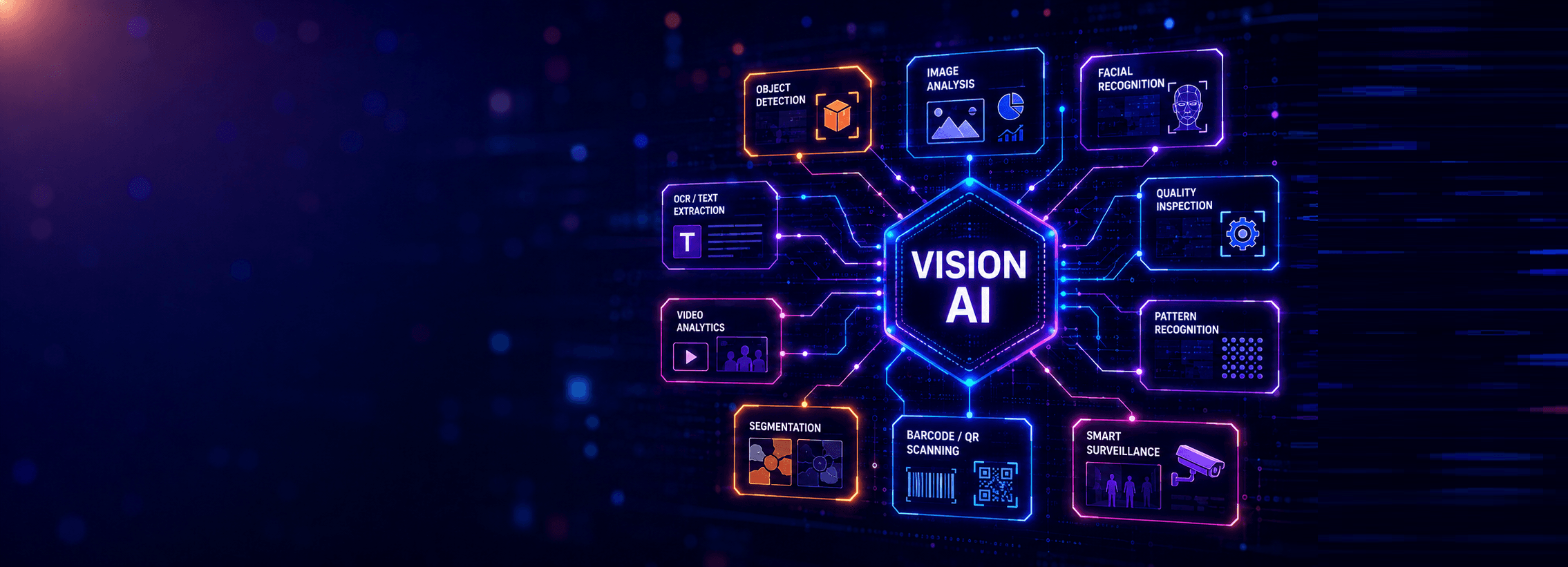
AI That Sees, Understands,
and Acts on Images.
Production-ready computer vision systems, from quality inspection and object detection to real-time video analytics and document intelligence.
The Numbers Behind AI Computer Vision
Computer Vision AI, For Real Business Outcomes
Computer vision is AI that interprets and acts on visual data, images, video, documents, and live camera feeds, with the same speed and accuracy a team of expert analysts would need hours to match.
We build custom vision pipelines trained on your data and integrated into your existing workflows, not generic demos that collapse under production conditions.
“Computer vision is not about 'seeing.' It's about acting on what is seen. Most solutions stop at detection. AGIX designs all three layers: perception, understanding, and action.”
From Visual Data → Recognition → Interpretation → Action
Eight Vision Capabilities.
One Unified Platform.
From detection to decision, every capability we build is production-hardened and trained on your domain data.
Where Vision AI Creates the Most Value
We've deployed vision systems across manufacturing, healthcare, retail, logistics, and more. The ROI is usually visible within the first 90 days.
Discuss Your Use CaseVision AI Built for Production, Not Demos
Most vision prototypes fail in production. Ours don't; because we design for your data variance, your edge cases, and your infrastructure from day one.
From Discovery to
Live System in 8 Weeks
A clear, milestone-driven process that keeps you in control at every stage, with a working prototype by week 3.
We examine your existing image/video data, define the detection targets, set accuracy benchmarks, and choose the right model architecture.
Annotate your training set, apply augmentation strategies, and build validation splits that reflect real-world variance, not curated samples.
Training runs with iterative evaluation against your benchmarks. You see precision, recall, and F1 metrics, not just "it works" promises.
Wrap the model in a production API, connect it to your existing systems (ERP, WMS, LIMS, etc.), and wire up alerting and logging.
Go live with full observability. Drift detection, confidence tracking, and an automated retraining trigger keep accuracy high as real-world conditions change.
What This Looks Like in Practice
How AGIX deploys Computer Vision AI across industries.
AI Visual Inspection for Manufacturing
Manufacturing line relies on human inspectors who miss micro-defects, fatigue during long shifts, and can't keep pace with production speed.
Capture: high-speed cameras capture every product on the line
Detect: AI finds surface defects, dimensional errors, assembly mistakes in real time
Act: defective units auto-rejected, line continues without pause
Log: defect data and images captured for root-cause analysis dashboard
AI Computer Vision vs Manual Inspection
Best-in-class tools selected for your use case
Scope-Based Pricing
No retainers. No hidden fees. You own everything we build.
One computer vision application; defect detection, OCR pipeline, or shelf monitoring.
Multi-camera or multi-use-case vision deployment with analytics dashboard.
Full vision infrastructure across facilities with edge+cloud hybrid and continuous retraining.
All pricing is project-based. You own the IP, source code, and all systems we build. Contact us for a scoped estimate.
Vision AI in the Real World
 Fintech
How Agix engineered an end-to-end AI document processing system that achieves 99.5% extraction accuracy across 5.7M+ financial documents…
The Challenge
Processing financial documents manually, income verification, deposit verification, tax return analysis, is slow,…
The Outcome
Measured 90 days post-deployment against pre-deployment baselines.
Extraction Accuracy
Avg Processing Time
 Grocery Retail
Agix built three integrated AI systems for Kroger, a multi-order pick path optimizer, computer vision item verification, and…
The Challenge
When order pickers fill grocery orders manually, they walk whatever path they remember, pick items in whatever order…
The Outcome
Measured against pre-deployment baselines across Kroger's e-commerce fulfillment network post-launch.
Items Per Hour
Pick Travel Distance
 Mental Health & Workplace Training
Agix built an end-to-end AI automation engine for Hello Driven; automating lead capture, coach matching, program enrolment, certification…
The Challenge
Driven's program library was expanding rapidly; new certifications, new coach tiers, new enterprise and government…
The Outcome
Measured against pre-deployment baselines across Driven's enrolment and coach operations.
More Coaches Onboarded
Faster Enrolment Process
Deep Dives on
Computer Vision AI
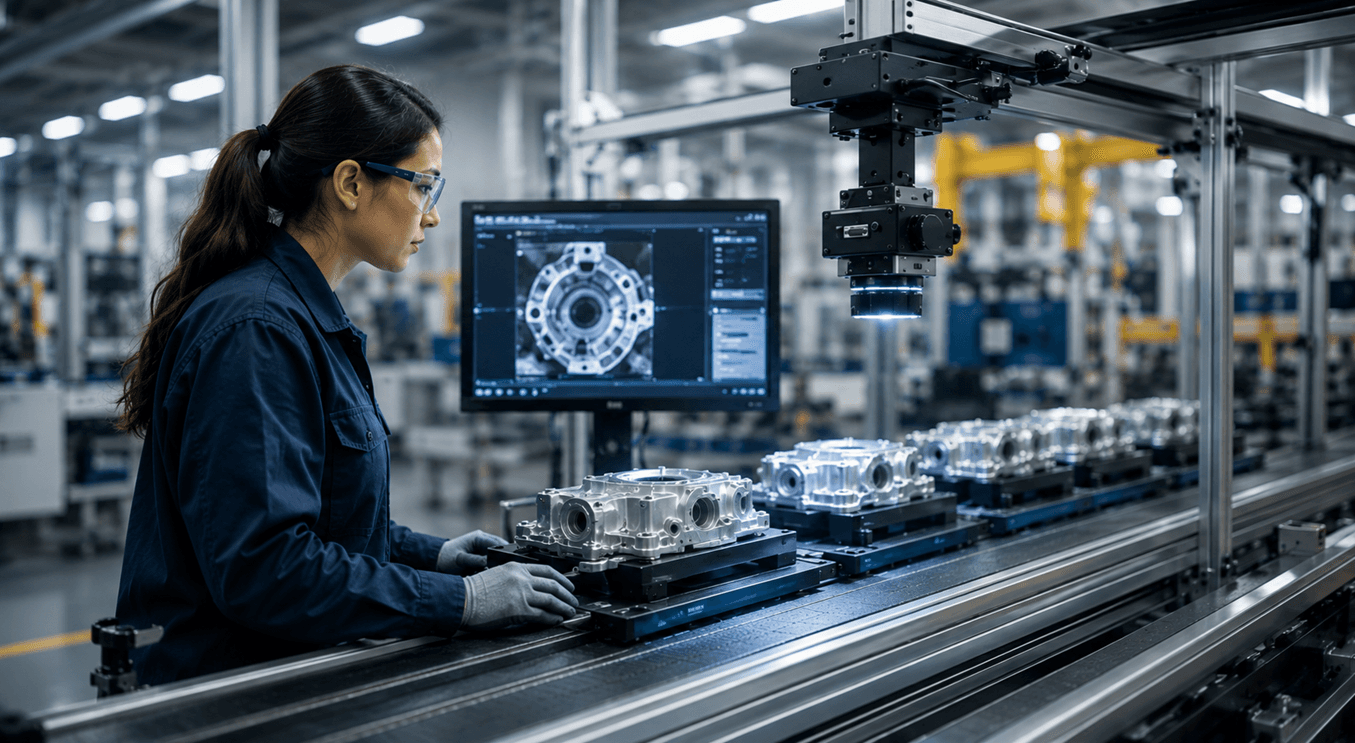
AI Visual Inspection for Manufacturing: Defect Detection Guide
Explore AI visual inspection for manufacturing with YOLO architecture, NVIDIA Jetson edge deployment, automated quality control, and 97.5% defect detection accuracy.
Read article
AI for Med Spas: Computer Vision, Scheduling Agents, HIPAA Architecture, and Revenue Optimization
Technical guide to AI for med spas covering computer vision skin analysis, scheduling agents, HIPAA-safe architecture, and revenue optimization.
Read article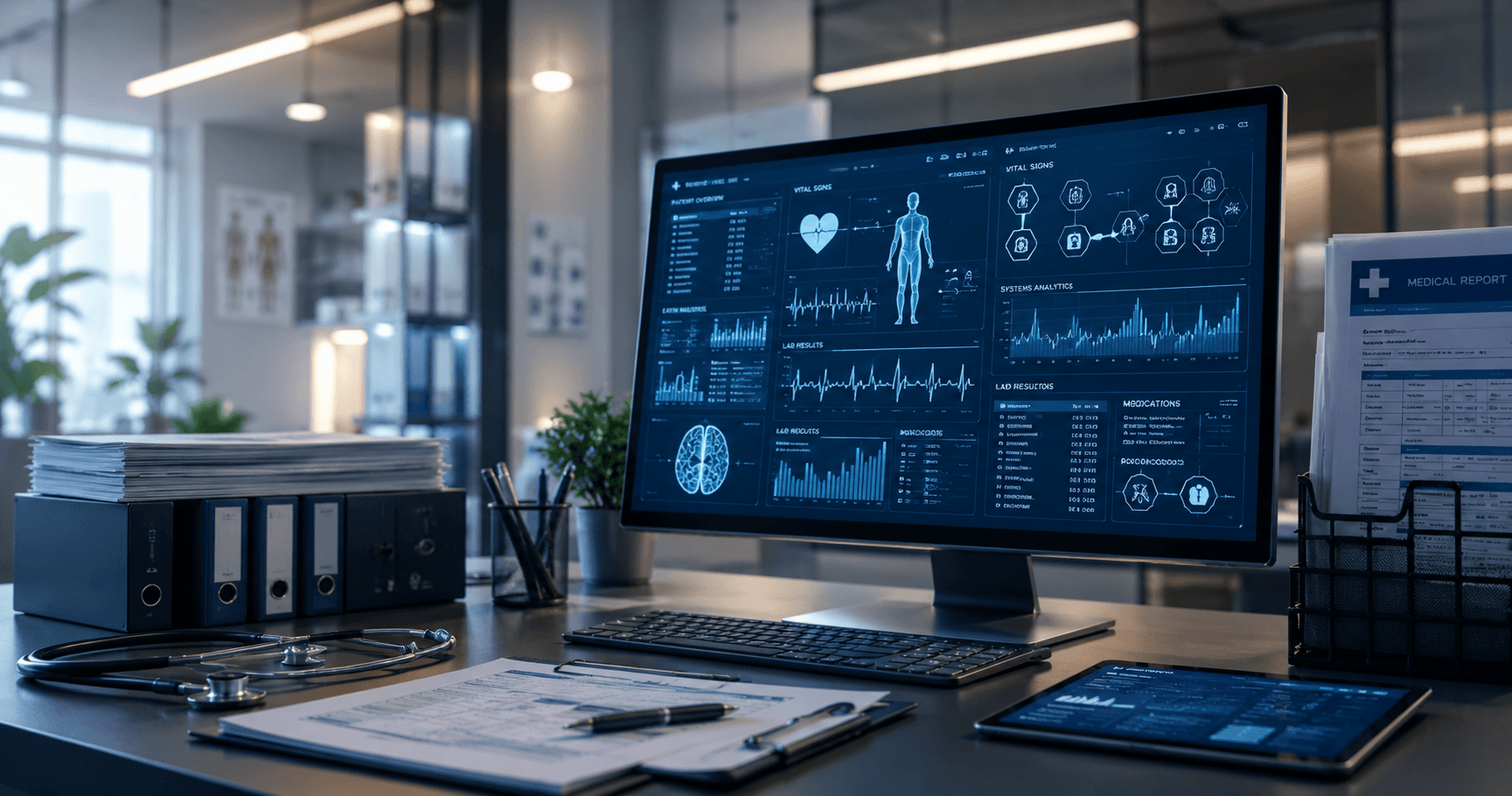
AI in Healthcare: Use Cases, Benefits HIPAA-Compliant Implementation Roadmap
Explore AI in healthcare, including top use cases, benefits, HIPAA compliance, implementation roadmap, EHR integration, challenges, and best practices.
Read articleFAQ
It depends on the task. For structured defect detection, 500–2,000 labeled images are often enough to hit 95%+ accuracy. We can also use data augmentation and transfer learning to work with what you have, and supplement with synthetic data generation when needed.
Yes, in most cases we work with your existing IP cameras or industrial cameras via RTSP/ONVIF streams. For edge deployments, we optimize models for NVIDIA Jetson or Raspberry Pi hardware. No rip-and-replace required.
Generic vision APIs are trained on broad internet data, they've never seen your specific products, your defect types, or your document formats. Custom-trained models typically outperform them by 15–40% on domain-specific tasks.
We build model drift monitoring into every deployment. When confidence scores degrade past a threshold, the system flags it and queues new samples for labeling. Retraining is automated, your model self-heals as your environment evolves.
100%. You own the trained model weights, the labeling pipeline, the inference API code, and all documentation. We don't retain usage rights or license anything back to you.
Ready to Build AI Computer Vision?
Tell us your visual inspection challenge and we'll map out exactly how AI Computer Vision can solve it, with real timelines, real costs, and a clear starting point.