
AI That Teaches Through
Questions, Not Answers
Agix built Q-Chat, Quizlet's Socratic AI Tutor, delivering +67% learning gains and 89% misconception resolution across 60M+ students through adaptive questioning that builds genuine understanding instead of giving away answers.
The world's most popular study platform, serving 60M+ learners across 130+ countries.
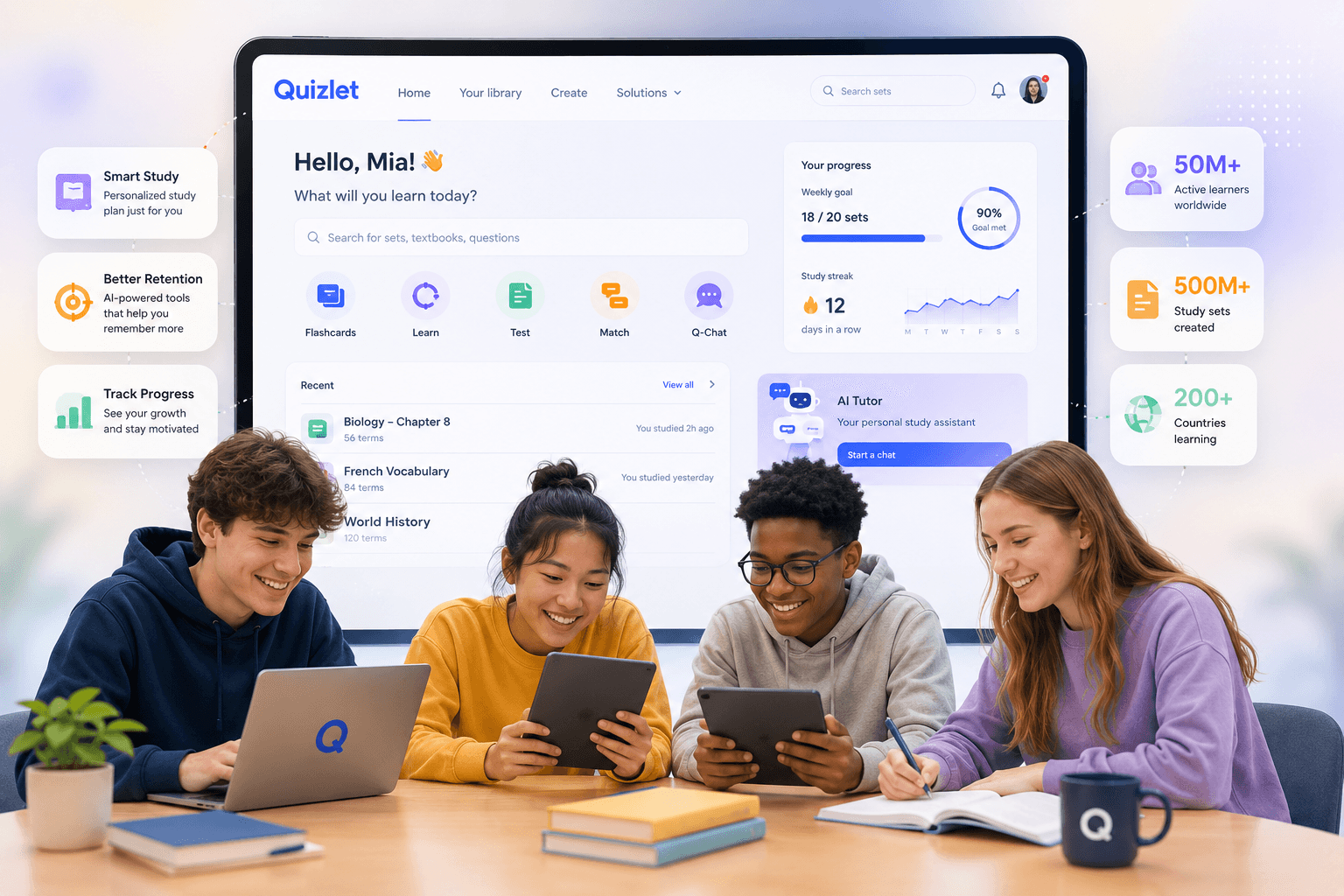
Founded in 2005, Quizlet is the dominant study tool in global education, 300M+ students and teachers rely on it across 130+ countries. Its 500M+ user-generated study sets span every subject imaginable, accessible through Flashcards, Learn, Test, and Match modes that help students retain information through spaced repetition and active recall.
Yet despite this scale and reach, Quizlet's core tools remained fundamentally passive. Students could flip flashcards endlessly and still fail their exam, drilling surface-level recall without ever confronting the misconceptions beneath. When AI assistants arrived promising instant answers, students began bypassing active recall entirely. Quizlet needed an AI that taught, not one that shortcutted. Agix was brought in to build it.

300M study sessions. Millions of misconceptions never caught. And AI making it worse.
Quizlet's existing study tools rewarded completion, not comprehension. Students who answered "correctly" on a flashcard flip might still hold fundamental misunderstandings, and the platform had no mechanism to surface or resolve them. When AI chatbots entered the picture, they made things worse: students copy-pasted homework questions and got direct answers, bypassing the effortful retrieval that makes learning stick.
From passive study to Socratic mastery. At 60M-student scale.
Q-Chat, Adaptive Mastery Engine, Knowledge State Modeling, and Teacher Insight Dashboard, all connected through a single AI platform that builds real understanding one question at a time.
Six interconnected AI systems that turn study time into genuine understanding.
Agix built Q-Chat and five supporting systems, translating 60M+ students' learning behaviors into Socratic dialogue, concept-level mastery tracking, and teacher-visible insight at scale.
Q-Chat Socratic Question Engine
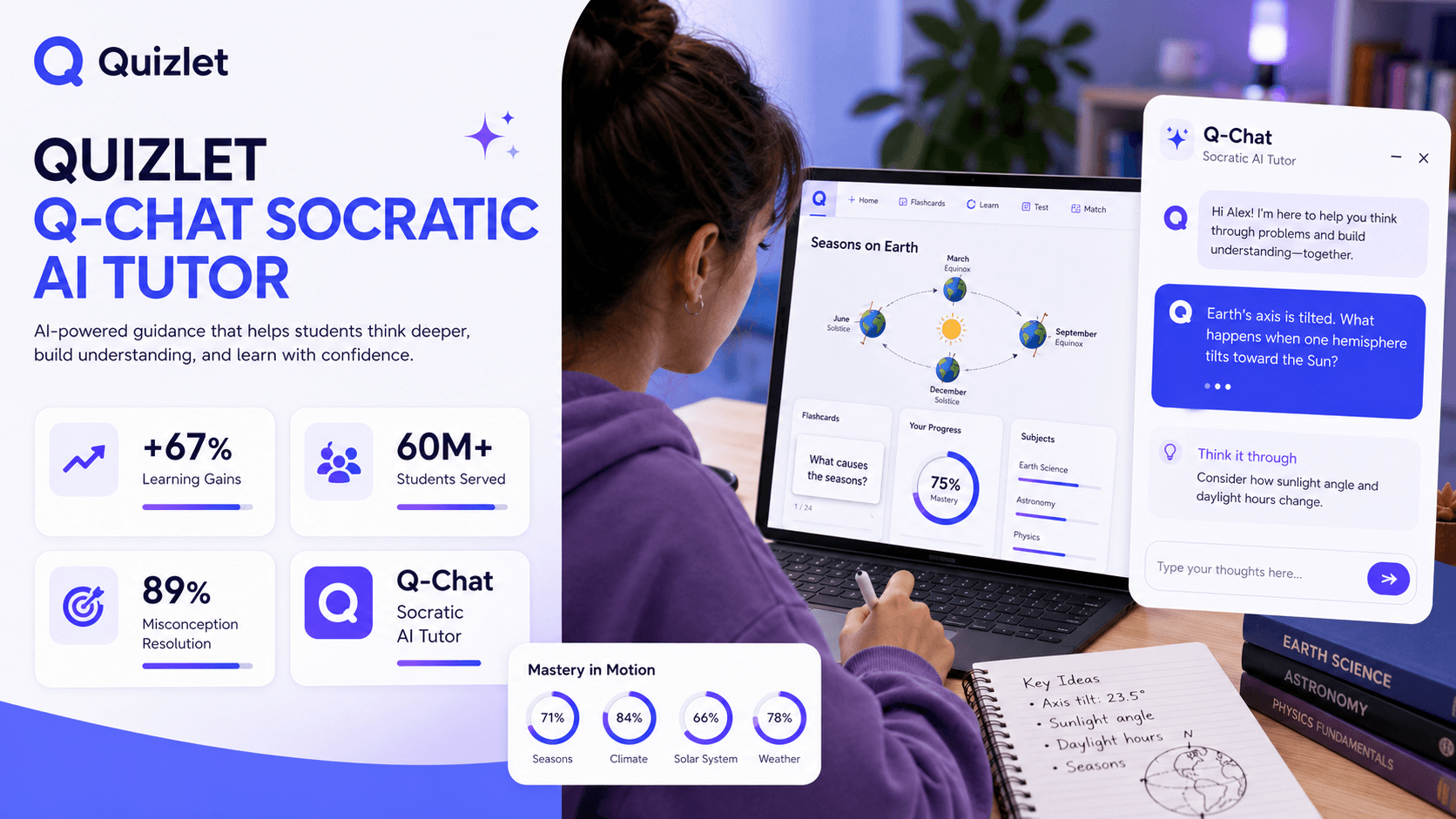
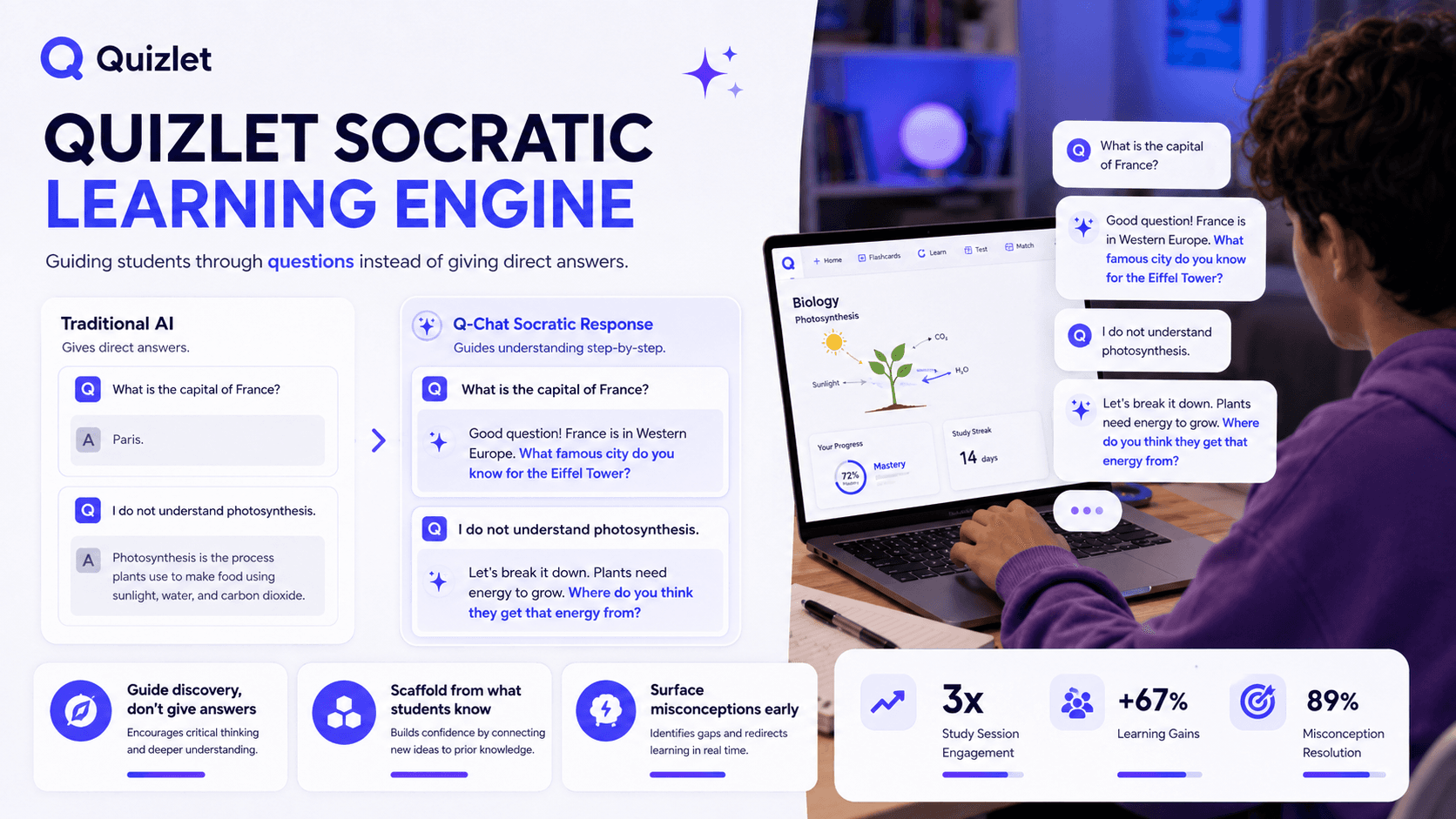
The core of Q-Chat: an AI that guides students through problems using Socratic dialogue instead of direct answers. When a student asks "What is photosynthesis?", Q-Chat responds with a guiding question, "What do you think plants need to make food?", scaffolding from the student's existing knowledge toward the correct concept. The engine is trained on educational dialogue patterns, knows each student's current knowledge state, and adjusts question complexity based on their confidence and prior responses. It never gives away the answer. Every exchange builds retrieval strength.
Knowledge State Modeling
A persistent model of each student's conceptual understanding that tracks what they know, what they've partially understood, and where misconceptions are actively held, updated after every Q-Chat exchange, practice question, and study session. Unlike simple progress tracking, the knowledge model maps relationships between concepts: a misconception about cell membranes flags the student for targeted follow-up on transport proteins and osmosis. The model enables Q-Chat to meet each student exactly where they are, rather than delivering the same dialogue regardless of prior understanding.
Misconception Detection & Resolution
A dedicated model that identifies wrong mental models from student responses, not just incorrect answers, but the specific misconception behind the error. When a student says "plants get energy from soil," the system identifies the photosynthesis misconception precisely, selects a targeted remediation path, and routes Q-Chat's next questions specifically to resolve it. The misconception library spans 40+ subject domains and 2,000+ documented student misunderstandings, enabling resolution sequences that are provably more effective than re-explaining the correct concept.
Adaptive Difficulty Calibration
A difficulty engine that continuously adjusts question complexity, scaffolding depth, and session pacing based on each student's real-time performance and confidence signals. When a student answers confidently and correctly, the engine increases conceptual complexity and reduces scaffolding. When confidence is low or errors occur, it adds intermediate steps and returns to foundational concepts. The calibration model targets the student's zone of proximal development, keeping each session productively challenging without tipping into frustration. Average mastery per concept was achieved in 4 sessions vs. the prior 9-session average.
Teacher Insight Dashboard
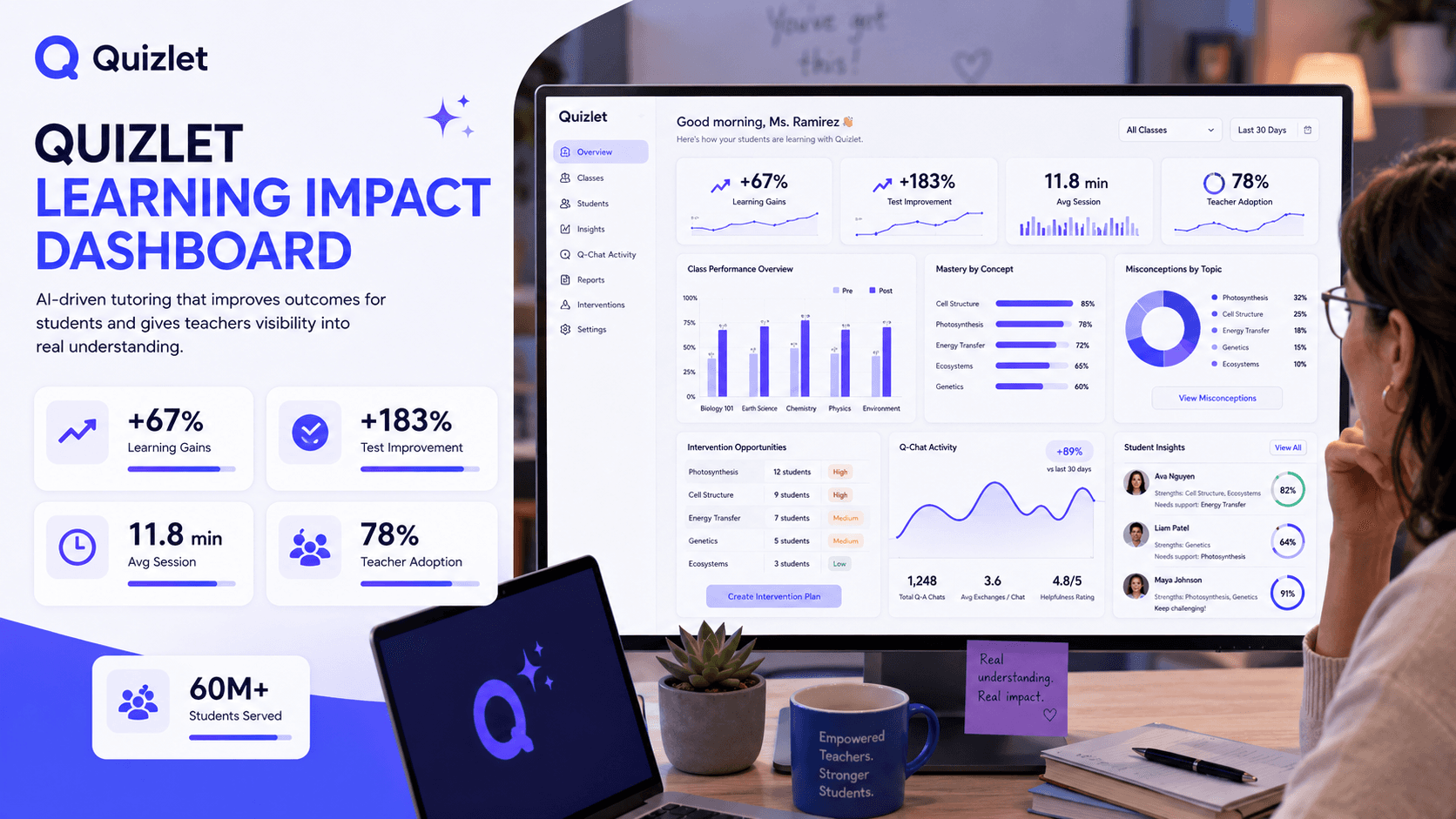
Real-time class-level visibility into concept mastery, misconception clusters, and individual students who need support, surfaced automatically from Q-Chat sessions without requiring teacher review of individual transcripts. The dashboard shows which concepts the class has mastered, which remain weak, which specific misconceptions appear in more than one student, and which students are at risk of falling behind. Teachers receive weekly summary emails with intervention recommendations, enabling targeted small-group instruction on exactly the concepts where the class is struggling most.
Curriculum-Aligned Content Layer
An alignment engine that maps Quizlet's 500M+ study sets to learning objectives from 60+ national and state curricula, ensuring Q-Chat dialogue is grounded in content that's relevant to each student's specific course and exam. When a student studies AP Biology Chapter 8, Q-Chat pulls Socratic question sequences calibrated to College Board learning objectives, not generic biology content. The layer also surfaces related study sets a student hasn't encountered, filling knowledge gaps that their self-curated set list left open, and flagging study sets that are factually inconsistent with authoritative curriculum sources.
Every layer of the learning system, built for real impact.
Guides students through problems with questions, not answers, building real understanding step by step
Tracks concept-level understanding across sessions, resolving misconceptions one session at a time
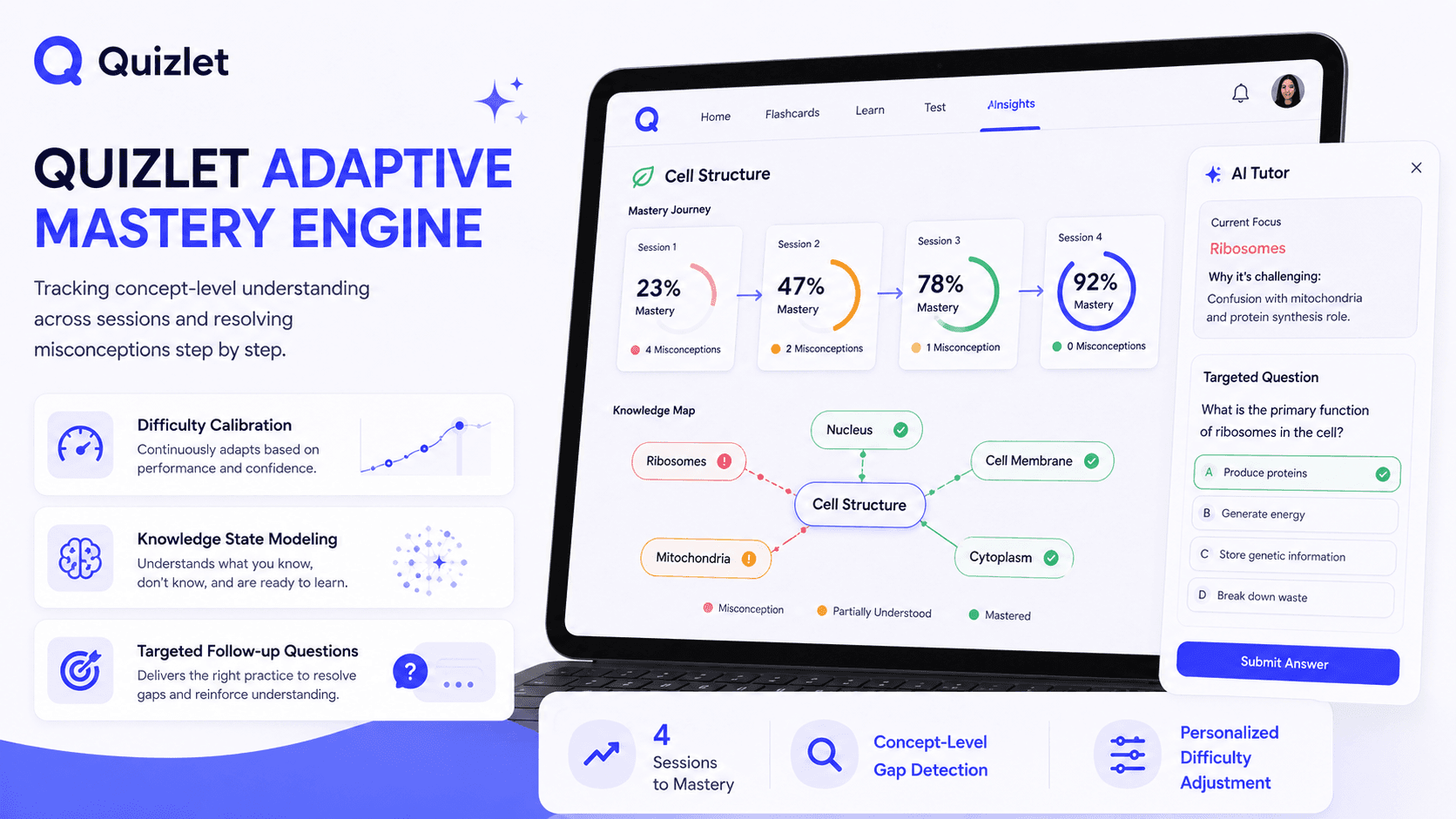
Compared to direct-answer AI, 3× study session engagement and 89% misconception resolution
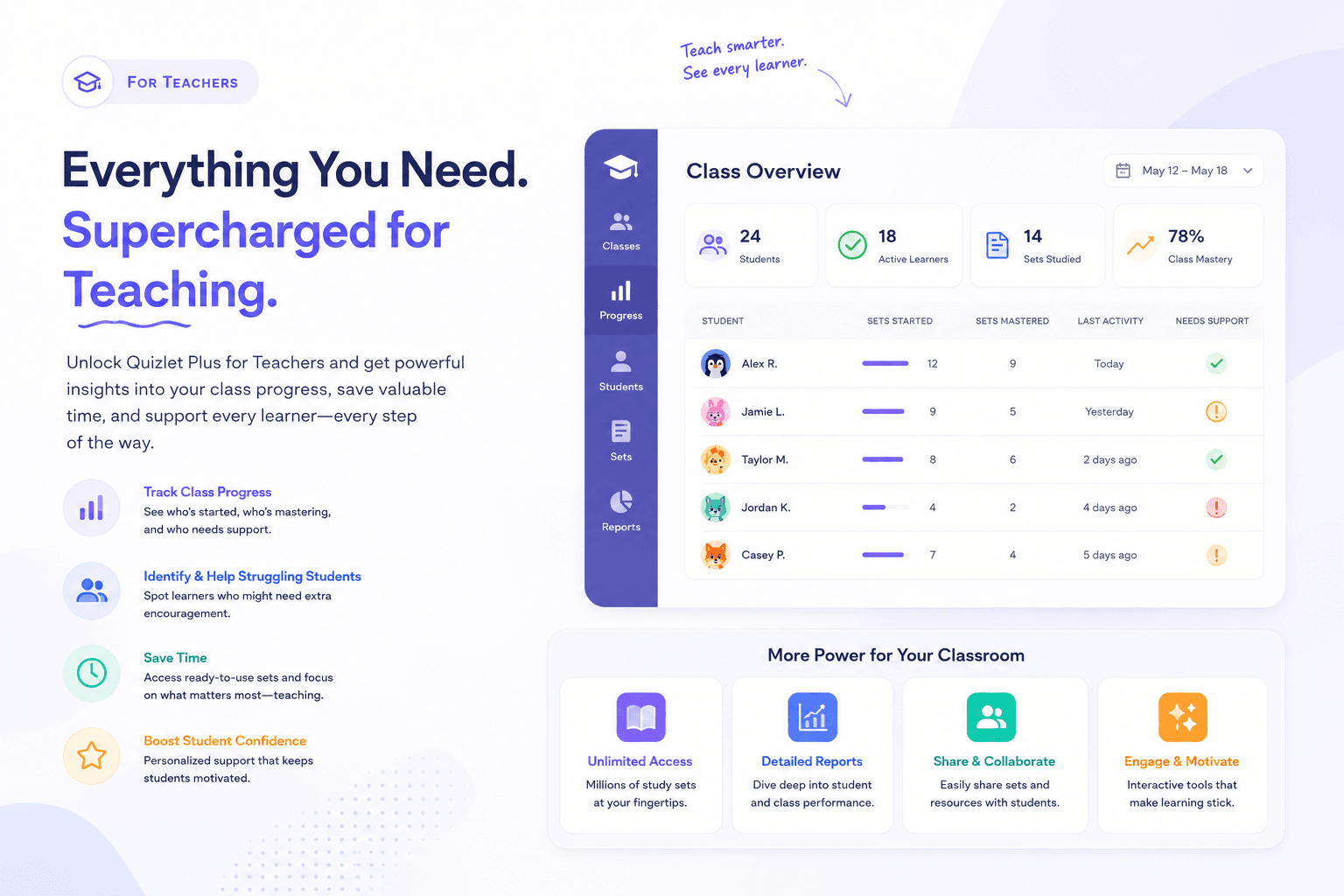
Real-time class mastery, misconception clusters, and at-risk student flags, surfaced automatically
What happened when students learned through questions instead of answers.
Measured across 60M+ student sessions within 12 months of Q-Chat deployment.
Pre/post assessment improvement across Q-Chat users vs. flashcard-only control group
Average exam score uplift among students who completed Socratic learning sequences before assessments
Up from 4.2 min with passive flashcards, a 3× increase driven by active Socratic engagement
Of detected misconceptions resolved within a single Q-Chat session when targeted by the remediation engine
Of Quizlet Teacher accounts actively using the Insight Dashboard for class intervention planning
Across 130+ countries, all receiving Socratic AI tutoring calibrated to their individual knowledge state
Q-Chat didn't just add an AI feature to Quizlet, it fundamentally changed what learning on our platform means. Students are spending three times longer in sessions not because they're stuck, but because they're genuinely engaged. The misconception resolution data was what convinced our learning scientists: this is how AI should teach.
Three design choices that separated Q-Chat from every other EdTech AI.
Questions, not answers, as the primary output
Most AI tutors tell students what to think. Q-Chat asks questions that lead students to figure it out themselves, a fundamental design principle rooted in 50 years of educational research showing that effortful retrieval dramatically outperforms passive review for long-term retention. This single constraint, never give the direct answer, forced every other architectural decision.
Misconception-first, not answer-first, evaluation
Standard AI systems grade correct vs. incorrect. Q-Chat identifies the specific wrong mental model behind each error, and delivers a targeted resolution sequence for that exact misconception rather than re-explaining the topic generically. Students who held a specific misconception and received targeted remediation resolved it 89% of the time in a single session, compared to 31% with standard re-explanation.
Teacher visibility baked in from the start
Rather than building a student-only AI that teachers learn about secondhand, Agix designed the data architecture to surface class-level insight as a first-class output from the first session. Every Q-Chat exchange produces a teacher signal. The 78% teacher adoption rate reflected that the dashboard gave teachers something genuinely actionable, not a dashboard for dashboard's sake, but a direct replacement for the guesswork that had preceded it.
Is a Socratic AI Tutor the right build for your EdTech product?
What powers this system.
Socratic Conversational AI
Dialogue systems built to guide through questions rather than dispense answers, the architectural foundation for any AI that needs to build understanding rather than provide shortcuts.
Knowledge State Modeling
Persistent per-user cognitive models that track what someone knows, is building toward, and misunderstands, enabling every AI interaction to begin from an accurate representation of their current understanding.
Misconception Detection Engine
Classification models trained on domain-specific wrong mental models, identifying not just incorrect answers but the precise misconception beneath them, enabling targeted remediation rather than generic re-explanation.
Teacher & Admin Insight Dashboards
Operational intelligence layers that translate student or user AI interactions into actionable signals for educators, managers, or administrators, surfacing what's working, what's failing, and who needs attention.
Adaptive Difficulty Calibration
Dynamic difficulty engines that adjust challenge level, scaffolding depth, and pacing in real time based on individual performance, keeping users in the optimal learning zone without manual curriculum design.
EdTech AI Systems
End-to-end AI for learning platforms, from Socratic tutors and mastery engines to curriculum alignment and teacher visibility layers, built for measurable learning outcomes, not just engagement metrics.
Common questions about Socratic AI tutoring for learning platforms.
Q-Chat almost always responds with a question rather than a direct answer, this is a core design constraint, not a situational choice. The exceptions are narrow: procedural or factual lookups where understanding isn't the goal (finding a formula, checking a definition, confirming a date), or when a student has already reasoned through most of a problem and simply needs confirmation of their final step. In comprehension-building contexts, Q-Chat never gives the answer directly, regardless of how the student phrases the request. Students who ask "just tell me the answer" receive a Socratic response instead, with an explanation of why working through it produces better retention.
The knowledge model maintains separate concept graphs per subject domain, a student's mastery of cellular respiration doesn't interfere with their French vocabulary knowledge state. Within a domain, concepts are relationally mapped, so mastering one concept adjusts confidence estimates for related concepts in the same graph. Cross-domain learning is tracked at the session level rather than the concept level, allowing Q-Chat to understand things like a student's general problem-solving confidence or tendency toward guessing over reasoning, and apply those meta-learning signals across all subject interactions.
The Adaptive Difficulty Calibration layer detects frustration signals, repeated incorrect responses, declining answer confidence, session abandonment patterns, and shifts the dialogue strategy before the student gives up. When a student is genuinely stuck, Q-Chat reduces the complexity of its guiding questions, introduces more scaffolding, and may suggest returning to a foundational concept that's a prerequisite for the current one. In extreme cases, it surfaces the foundational information the student is missing as direct context, then re-engages Socratic dialogue from that foundation. The system monitors frustration vs. productive struggle and calibrates the intervention threshold per student.
Yes. The Socratic architecture adapts naturally to any domain where understanding matters more than task completion, compliance training, technical certification, clinical protocol training, regulatory knowledge. The key requirement is a structured concept map and misconception library for the target domain. In K-12 and higher ed, this infrastructure already exists through curriculum standards. In enterprise domains, we typically build it during the first phase of engagement by analyzing existing training content, past assessment results, and interviewing subject matter experts. Deployment time for enterprise Socratic systems is typically 12–18 weeks for the first domain.
The Teacher Insight Dashboard surfaces aggregated and individual-level mastery data, not raw Q-Chat transcripts. Teachers see concept mastery percentages, misconception flags, and at-risk student identifiers, not the conversation content between a student and the AI. Individual Q-Chat conversations are private to the student. The data architecture is designed to comply with FERPA and COPPA requirements for student data in educational contexts, and all personally identifiable information is handled under Quizlet's existing data governance policies with no additional data exposure created by the Q-Chat system.
Ready to build an AI that teaches, instead of one that answers?
Most projects go from kickoff to deployed AI system in 8–16 weeks. Let's talk about what a Socratic AI tutor, knowledge state model, and teacher insight layer could do for your learning platform's outcomes.